
Does Home Staging Really Help Sell a House?
Why Presentation Can Pay Off ?
When homeowners prepare to sell, one question comes up again and again: Is home staging really worth it?
After all, the house itself doesn't change. The square footage is the same. The location is the same. The number of bedrooms and bathrooms is the same. So why spend money staging it? Because buyers don't experience a home as a list of specifications. They experience it visually and emotionally first — and then justify that feeling with the numbers. Professional home staging is designed to make that first experience as strong as possible. It helps buyers understand the space, see the home's potential and, most importantly, imagine themselves living there. And according to recent real estate industry research, that can have a meaningful impact on how buyers respond to a property.
Selling a Home Is Also About Selling the Experience
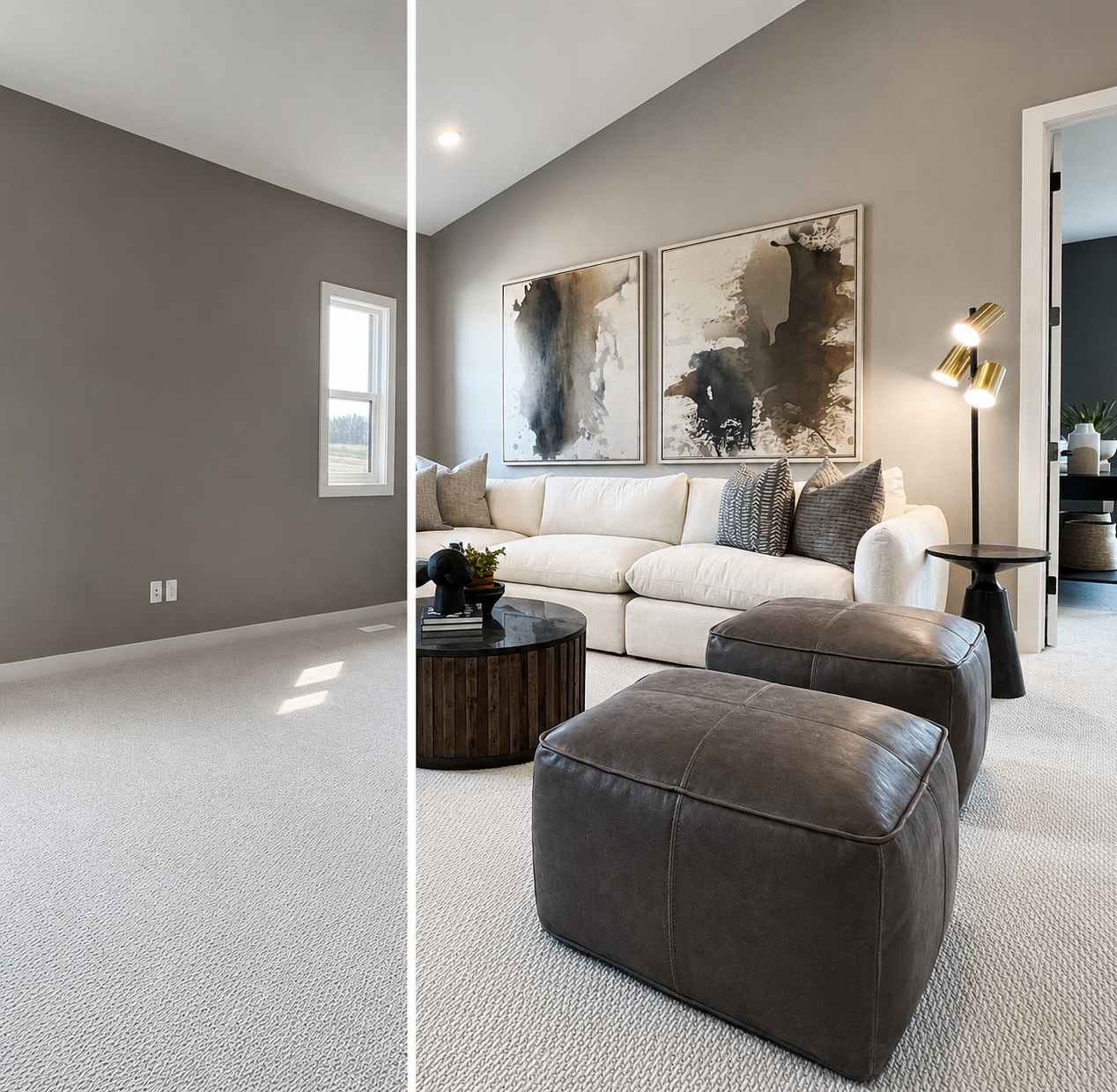
Think about two similar homes listed in the same neighborhood at a similar price. One is vacant, with empty rooms and little sense of scale. The other has a carefully arranged living room, an inviting dining area, a beautifully presented primary bedroom and accessories that complement the home's architecture. On paper, the two properties may be very similar. But to a buyer, they can feel completely different. One feels like an empty property. The other feels like a home. That distinction is exactly where professional staging creates value.
According to the National Association of REALTORS® 2025 Profile of Home Staging, 83% of buyers' agents said staging made it easier for buyers to visualize a property as their future home. That is an important number because visualization is one of the biggest hurdles in selling real estate. Many buyers simply aren't good at mentally furnishing an empty room, overlooking awkward furniture placement or imagining what a dated or cluttered space could become. Professional staging does that work for them. Instead of asking buyers to imagine the potential, you show them the potential.
The First Showing Usually Happens Before Buyers Walk Through the Door
Today's buyer often sees your property for the first time on a phone. They scroll through listing after listing, sometimes making a decision within seconds about whether a property deserves a closer look. That means your listing photos aren't simply documenting your home. They are advertising it. And staging can dramatically change how those photographs feel. A thoughtfully staged room helps establish:
Scale
Function
Furniture placement
Traffic flow
Lifestyle
Warmth
Visual balance
An empty room can be surprisingly difficult to judge from a photograph. Buyers may wonder whether their sofa will fit or whether a dining area is actually large enough for six people. A staged room answers those questions immediately. According to NAR's 2025 research, 31% of buyers' agents said buyers were more willing to walk through a home they had seen online when it was staged. That's significant. Because before staging can influence an offer, the listing first has to earn the showing.
Staging Helps Buyers See Value, Not Just Furniture
One misconception about staging is that it is simply decorating.
It isn't. Interior decorating is about creating a space that reflects the homeowner's personal taste.
Home staging is about positioning a property for the market.
A professional stager looks at the home through the eyes of a potential buyer. Which features should attract attention? Does the room feel larger or smaller than it actually is? Is the furniture hiding an architectural feature? Does the property feel consistent from one room to another? Is an awkward area being wasted when it could become a home office, reading corner or functional dining space? Should the eye be drawn toward the fireplace, the windows, the ceiling height or the view? Every piece has a purpose. When staging is done well, buyers shouldn't walk away thinking:
"That was beautiful furniture."
They should walk away thinking: "I really like that house."
Can Staging Help You Get a Better Offer?
There is no responsible way to promise that staging will automatically increase the selling price of every home. Location, market conditions, pricing, inventory and property condition still play major roles. But there is evidence that staging can positively influence what buyers are willing to offer.
In the 2025 NAR Profile of Home Staging, 29% of real estate professionals reported that staging resulted in an increase of between 1% and 10% in the dollar value offered. That doesn't mean every staged home sells for 10% more. But when you're dealing with one of the largest financial transactions most homeowners ever make, even a relatively small improvement in buyer perception can matter. And there is a reason for that. Buyers don't evaluate properties in isolation. They compare them. If several homes fall within the same budget, the question becomes:
Which one feels like the best home for the money?
Professional presentation can help your property become that home.
A Well-Presented Home Can Feel More Valuable
Consider how consumers respond to almost any high-value purchase. Cars are detailed before they are displayed. Luxury retail products are carefully lit and presented. Builders professionally furnish their show homes. Hotels invest heavily in design, photography and atmosphere.
Why?
Because presentation influences perceived value. Real estate is no different. A professionally staged property can feel:
Larger
Brighter
Cleaner
More functional
More current
More comfortable
More memorable
The goal isn't to hide problems or make a property appear to be something it isn't. The goal is to make sure buyers see the home's strongest qualities immediately.
Staging May Also Help Protect Your Most Valuable Selling Period
There is another staging benefit that homeowners sometimes overlook:
time.
A new listing receives its greatest burst of attention when it first enters the market. Buyers who have been waiting for properties in that neighborhood or price range may see it immediately. That first wave of exposure is difficult to recreate later. If the photos aren't compelling or the property doesn't show well, some of those buyers may simply move on. Weeks later, the conversation can change. Instead of: "Did you see that new listing?" buyers may begin asking: "Why hasn't that house sold yet?"
That change in perception can affect negotiating leverage. This is one reason staging before listing can be more powerful than staging after a property has already struggled. NAR's 2025 research found that 49% of sellers' agents reported that staging reduced the amount of time their listings spent on the market. Thirty percent observed a slight reduction, while another 19% reported a significant reduction. Again, staging isn't a cure for incorrect pricing. But when the home is priced properly, strong presentation can help the listing make the most of its initial market exposure.
The Cost of Not Staging Is Worth Considering Too
Sellers naturally look at the cost of staging. But there is another side to the calculation:
What could weak presentation cost?
A buyer who skips the listing.
A showing that never gets booked.
A room that looks smaller online than it actually is.
A buyer who likes the home but doesn't feel emotionally connected to it.
A listing that sits longer than competing properties.
Or eventually, a price reduction designed to generate renewed interest. This is why staging should not simply be viewed as an expense. It is better understood as part of the marketing investment behind the sale. You already have the product — your home. Staging is about presenting that product effectively.
Calgary Buyers Currently Have Choices
This is particularly relevant in today's Calgary market.
According to CREB®'s July 2026 housing statistics, Calgary recorded 1,904 residential sales, approximately 9% fewer than July 2025. The residential benchmark price was $569,200, approximately 2% lower year-over-year, while average days on market increased from 37 to 40 days. Market conditions vary substantially by property type and neighborhood, but the broader message for sellers is clear:
buyers have choices.
When several comparable properties are competing for the same buyer, simply being "good enough" may not be enough to stand out.
Pricing matters.
Location matters.
Condition matters.
And presentation matters too. You may not be able to change your home's location or square footage before selling. But you can change how buyers experience them.
Staging Can Make Small Rooms Feel Purposeful
One of the most powerful things staging can do is remove uncertainty. Consider an empty secondary room.
Is it a small bedroom?
An office?
A nursery?
Will a queen bed actually fit?
Without furniture, buyers may struggle to understand it. Place the right furniture in that same space and suddenly the answer becomes obvious. The same applies to:
Open-concept layouts
Large living rooms
Small dining spaces
Bonus rooms
Basements
Awkward corners
Flex spaces
Primary bedrooms
Staging gives every important space a clear purpose. Instead of buyers thinking about what they would need to fix, change or figure out, they can start imagining how they would live there. That is a much better mindset for a seller.
You Don't Necessarily Need to Stage Every Room
Professional staging also isn't about filling the entire house with furniture. The objective is to invest attention where it creates the greatest impact. NAR's 2025 study found that buyers' agents considered the living room the most important room to stage, followed by the primary bedroom and kitchen. These are also some of the spaces where buyers form their strongest impressions of a home. For many properties, strategic staging of key rooms can be more effective than trying to decorate every square foot. A good staging plan considers the property, the likely buyer and the marketing strategy before deciding what is actually necessary.
So, Is Home Staging Worth It?
For many sellers, we believe the answer is :
Yes — because you're not simply staging a house. You're preparing a product for one of the biggest sales of your life.
Professional staging cannot change the market. It cannot fix an unrealistic asking price. And it cannot move your house to another neighborhood.
But it can influence things sellers can control:
How buyers see the home.
How the home photographs.
How the rooms feel.
How easily buyers understand the space.
How memorable the listing becomes.
And how strongly buyers connect with the property.
Professional Home Staging in Calgary
At Dezin Group, we don't believe staging should make every property look the same. Every home has its own architecture, proportions, natural light, neighborhood, price point and target buyer. Our job is to identify what makes that particular property attractive — and make those qualities impossible to miss. Through carefully selected furniture, artwork, lighting and accessories, we create spaces designed to photograph beautifully, show beautifully and connect with buyers. Whether it's transforming a vacant property, refreshing an occupied home or preparing a listing for market, our goal is the same:
Help buyers see the home at its very best — from the first photo to the final showing.
Because when you're selling a home, you only get one chance to make the property feel new to the market.
Make that first impression count.